Canopy Newsletter 22
October 2026
Team
Please join us in welcoming Robert, Amy, Michael and Boris Robert, Amy, Michael and Boris Robert, Amy, Michael and Boris Robert, Amy, Michael and Boris to Canopy. They're already making an impact by supporting customers and helping us further strengthen the technical expertise behind the Canopy platform.
It's been a busy few months for the development team, with a significant number of improvements and new capabilities added across the Canopy platform. From performance enhancements to new simulation features, here are some of the highlights:
Feature Upgrades
We've been hard at work to deliver updates across all of the key aspects of the simulation stack. This has resulted in a record number of performance and reliability improvements over the summer, alongside commonly requested features.
Stay tuned too, because there's much more in the pipeline for the winter.
New Features
Added a 3D undertray contact model, with Fy components now influencing the chassis behaviour as well as the Fz, Fx, and My components. This comes with a wear energy model, enabling you to count and limit the amount of sliding energy accumulated in the plank contact points.
The thermal brake model now has an optional surface element, enabling more reactive surface heating with a more direct effect on disc friction and rim heating while also accurately modelling heat soak into the disc core.
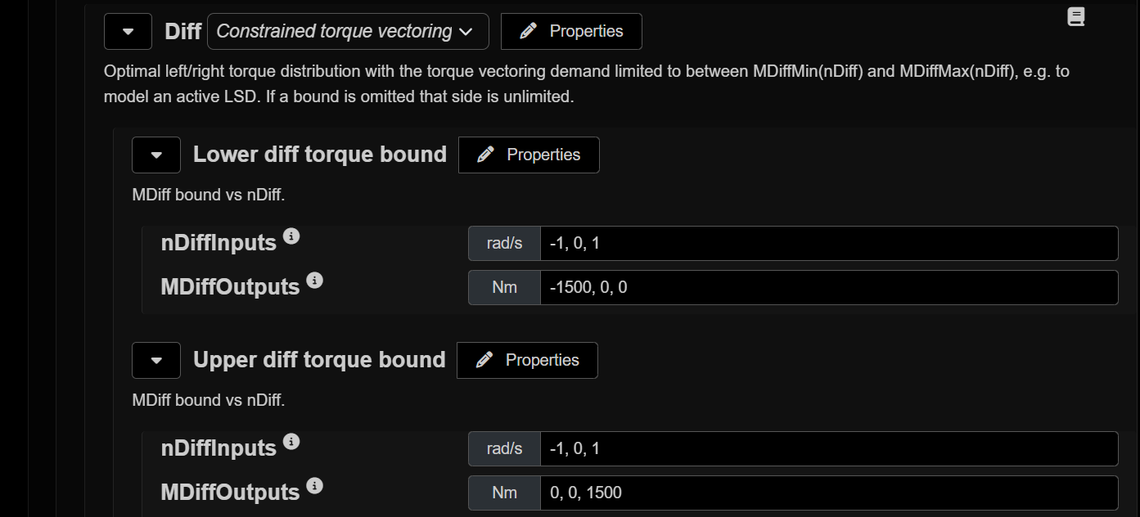
Major diff modelling improvements, including additional map inputs to the preload torque, torque transfer limits as a function of nDiff for restricting optimal torque vectoring options, and configurable preload torque adjustment rates. SLS channels on key differential inputs are also available.
Added the option to set a maximum vertical load on the tyre, FzTyreMaximumLimit*, which forces the solver to respect structural limitations on the tyre.
Expanded active ride height options including allowing it for cars with coilover
springs.
Migrated all Dynamic Lap simulation prerequisites from ApexSim to CorneringSim, providing better initialisation and solve quality. At the same time, we have made improvements in the robustness and available options in CorneringSim, including a configurable "powertrain mode" in which to run the QSS cornering test.
Work is ongoing to capture a greater range of F1 2026 regulations including more distance-based power and energy limits.
UI Updates
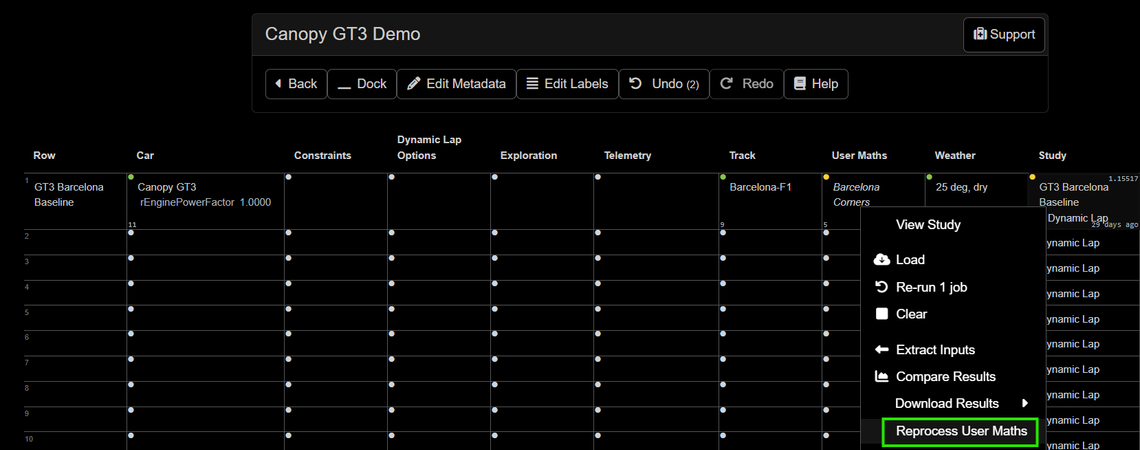
Easier user maths reprocessing. You can now reprocess a study with new user maths straight from the worksheet or from the study's "..." menu. While it runs, the study shows that it's reprocessing.
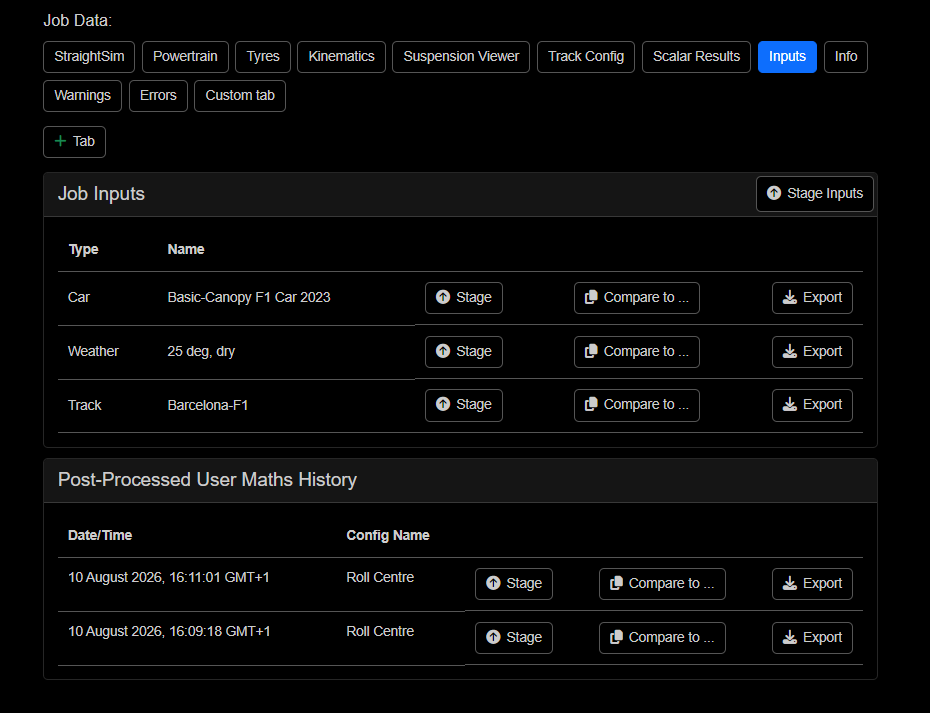
User maths history. The Study Inputs tab now lists every set of user maths a job
has been reprocessed with.
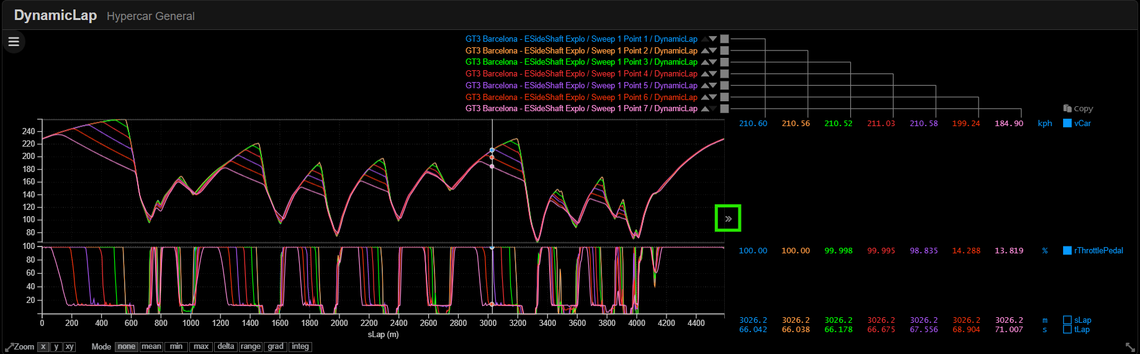
Better chart legends. Legends can hide or show values and remember which view
you last used.
Units on the Scalar Results view update correctly again when you change them.
Expressions containing <, > or & now display correctly in the config editor.
Links from Canopy to the documentation now take you to the right section of the article.
DiL Only
Add an optional DiL sRunReset input which can reset the DiL sRunRealTime accumulated distance to zero, helping with distance-based mapping options in DiL configurations.
Much more reliable DiL reset behaviour, for resetting the car back to track after an excursion.
Thermal overrides available to directly set brake and wheel rim temperatures in the DiL step.
Toolchain Improvements
SimLauncherLocal is now available targeting ARM architectures if you want to run our QSS and replay simulations offline in your own ARM tooling.
The Standard DiL is now available for Speedgoat's new Antelope operating system.
Internally, we have updated the VM image that our platform simulations run on, and added optimisations worth 30% in single-threaded Dynamic Lap execution time.
Results files are now stored in Parquet format, enabling far more efficient data storage and retrieval.
Fixes and Improvements
Updates to the names and definitions of signals, including correcting some reporting errors.
More schema validation, better descriptions, more logical layouts, and more detailed warnings and errors in the simulation code. Several "Unexpected Exit Code" errors now report more helpful messages.
Fixed a bug causing inaccurate wheel slip ratios when using hub motors and an inboard ICE. Also fixed an issue related to hub motor and brake disc reaction torques onto the unsprung masses.
Multiple bugfixes for edge case configurations and parameter combinations which weren't working as expected
Improvements to the reliability of asymmetric ride height constraints.
Added a default starting car approximating a GT3 model.
The Canopy Python Module
Canopy publishes a python module which contains direct access and some helpful wrappers to common API endpoints. The module can be found and downloaded directly from our GitHub: https://github.com/CanopySimulations/canopy-python.
Examples of how to use this tool can be found in our public examples repo: https://github.com/CanopySimulations/canopy-python-examples.
We are continuously developing and improving the tools in these repositories, and with the availability of coding agents they can often be a faster way to run complex studies and workflows.
Simulations run via the API and Python tools use the same cloud resources and count towards the same compute and storage credit limits as simulations run via the platform. Platform simulations can be viewed through the API and vice versa.
If you have any problems or questions about the code and options provided in our public GitHub resources, feel free to open an issue or a pull request to make a contribution!
Upcoming
Optional Mx (roll moment) input into the aero map, allowing left/right asymmetry on aero loads.
Refactor of electric motor P2P options, and similar options for increasing battery power limits.
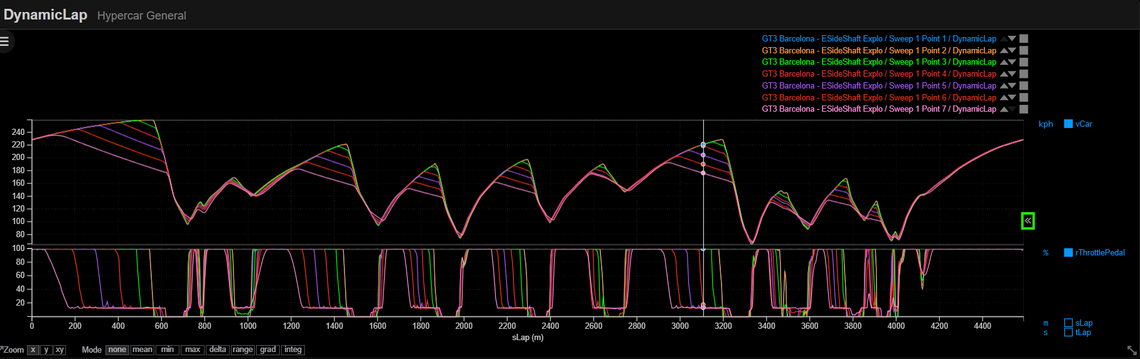
Add an "Illegal Energy Threshold" to mimic the WEC/IMSA rules on temporary exceedance of the side shaft power limit. We are also adding sLap-based zones in which side shaft energy can be restricted.
Formula E Gen 4 and F1 2026 Driver in the Loop Default Cars .
Dynamic Lap SLS and HD will become options that can be applied to any simulation type, including multi-lap and tyre thermal.
Improvements to the number of simulations which can be post-processed simultaneously.
These developments are driven by feedback from our customers and our commitment to helping teams work more efficiently and effectively. We look forward to bringing you further enhancements in the months ahead.
Simulate with Michelin Motorsport tyres from day one
Michelin Motorsport datasets are now available on the MICHELIN SIMIX platform.
Your setup decisions are only as solid as your tyre model. Access the SIMIX platform and access tyre datasets covering multiple racing championships and start vehicle simulations using tyre models prepared for simulation workflows. The datasets can be used directly in Canopy, without additional data post-processing, allowing teams to integrate tyre models into their simulation environment from the start of a project.
Developed from physical tyre measurements and correlated to real-world data representative of track operating conditions with state-of-the-art digital tools, the datasets support vehicle dynamics studies, setup investigations, and performance development activities.
More information is available on the SIMIX Motorsport page.
If the tyre model you need is not available in the catalogue, the SIMIX team can perform a dedicated characterization campaign, including for non-Michelin competition tyres, to generate simulation-ready models for your vehicle programme.
Browse the Motorsport catalogue
Feel free to reach out with any questions or feedback.
Your Canopy Team